SMART ATOM RETAIL · COMMUNITY AI
Turn one empty shop into an AI hub for the whole high street.
Smart Atom Retail puts shared AI, computing, connectivity, business tools, training and digital services into a real high-street location.
Residents can use AI.
Local businesses can share tools and computing they might not justify buying alone.
Developers can build.
Training providers can teach.
Councils and community organisations can provide digital services.
Neighbouring businesses can connect to the same shared infrastructure.
One shop becomes digital infrastructure for a whole street.
COMMUNITY AI · CEAC
CEAC · A dedicated 20ft Community AI data centre.
COMMUNITY AI · HIGH STREET
Smart Atom Retail · Shared Community AI for the high street.
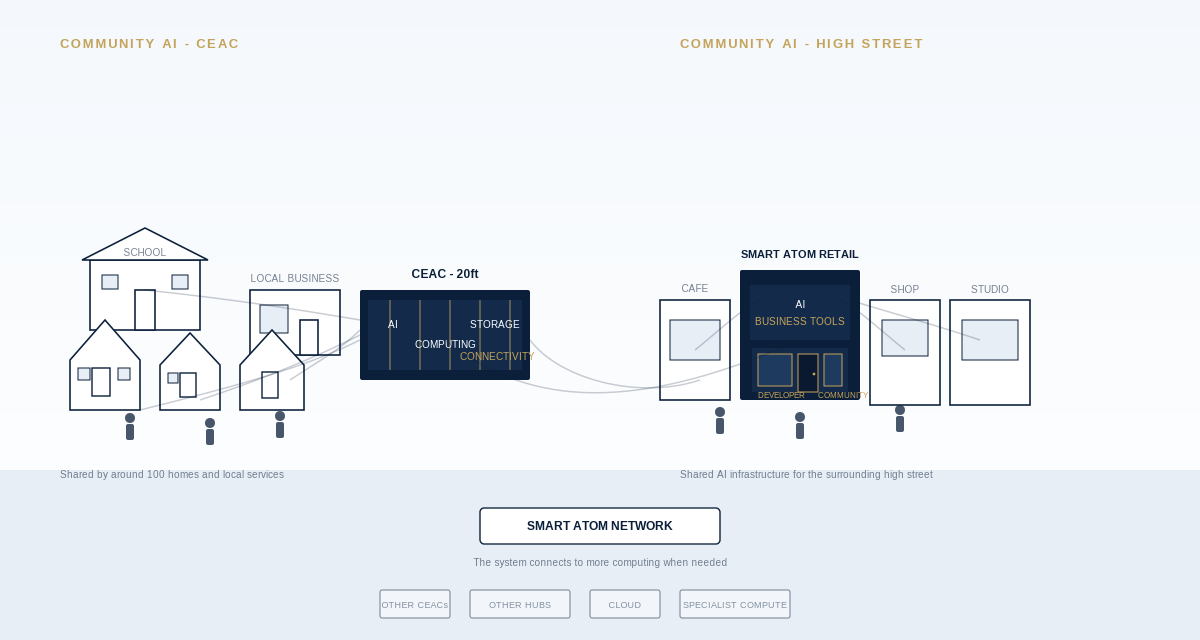
Infrastructure before enterprise.
Could one empty shop help the rest of the street come back?
High-street regeneration usually begins by asking how to fill vacant units.
Smart Atom Retail asks a different question:
Could one empty shop make the other shops more useful?
A Smart Atom Hub creates shared local infrastructure for AI, computing, connectivity, skills, business tools and digital services.
That infrastructure can then support the people and organisations around it.
One empty shop can help restart a whole street.
Free Community AI
Like free Wi-Fi for the AI age.
A useful layer of Community AI can be funded so people can access it free at the point of use.
Councils, regeneration programmes, property owners, technology partners, employers, universities, charities, data-centre partners, sponsors and Social Value programmes can fund Community AI access.
Commercial services for businesses, developers, training, workspace and specialist users can sit alongside the sponsored community layer.
The person using the service does not always have to be the person paying for the infrastructure.
Fund Community AIWhat can grow around a Smart Atom Hub?
New reasons to use the high street.
AI COFFEE SHOP
Coffee, co-working and accessible Community AI.
START-UP CAFÉ
AI-assisted research, planning, marketing, administration and digital tools for people starting businesses.
DEVELOPER SHOP
Coding environments, APIs, shared compute, prototyping and developer workspace.
ONLINE RETAIL HUB
A physical base for ecommerce businesses using shared digital tools, content and services.
CREATOR STUDIO
Video, podcasts, graphics, design and AI-assisted content production.
TRAINING CENTRE
AI literacy, coding, digital skills, apprenticeships and practical learning.
COUNCIL & COMMUNITY HUB
Human support alongside digital public and community services.
HEALTH & SCREENING
Digitally enabled premises for appropriately regulated healthcare partners. Clinical responsibility remains with the appropriate healthcare organisation.
The infrastructure is shared. The organisations using it do not have to be.
Community AI
Two ways to put shared AI infrastructure into a place.
Smart Atom Retail is one way to deploy Community AI.
CEAC is another.
They are independent physical deployment models built on the same wider Sparse technology stack.
SMART ATOM RETAIL
Shared Community AI infrastructure inside an existing high-street building.
It provides a visible place for residents, businesses, developers, training providers and community services to access AI, computing, connectivity and digital tools.
Explore Smart Atom RetailCEAC
A dedicated 20ft local data centre providing AI compute, storage, networking, protected power, cooling, monitoring and physical security.
Generation-1 is engineered around approximately 100 households.
Explore CEACSmart Atom Retail and CEAC can operate independently. Both can connect to other Smart Atom locations, CEACs, cloud infrastructure and specialist computing through Smart Atom Router.
Smart Atom Retail and CEAC are two independent ways to deploy Community AI. They share the wider Sparse technology stack, but neither depends on the other.
The same network underneath both
You use the AI. Sparse works out where the computers are.
A person, business, device or service asks for something.
NOVAS understands the work.
Smart Atom Router determines which computing resources are permitted, trusted, capable and available.
The work can then run on:
- the local Smart Atom Retail hub
- a CEAC
- another Smart Atom location
- another CEAC
- local CPU or GPU
- neuromorphic compute
- approved cloud infrastructure
- specialist computing
The user does not have to choose the machine.
The work comes first. The infrastructure follows.
See how Community AI worksThe AI people actually use
NOVAS
NOVAS is the intelligence and orchestration layer across the Sparse system.
It understands the request, works with relevant memory and context, coordinates tools and capabilities, applies governance and passes executable work into Smart Atom Router.
It is not a single model.
Models can change without rebuilding the surrounding memory, governance, routing and infrastructure system.
NOVAS understands the job. Smart Atom Router finds the right place to run it.
Explore NOVASThe secure compute decision layer
Smart Atom Router
Smart Atom Router decides where eligible computing happens.
It first determines which resources are permitted, trusted and capable of processing the workload.
Only then does it choose between the eligible options.
Routing can consider:
- locality
- capability
- availability
- latency
- resilience
- cost
- energy
- carbon evidence
A cheaper route cannot override a security restriction.
A greener route cannot override a data policy.
Use the right compute for the work.
Explore Smart Atom RouterCEAC
Community AI in a dedicated 20ft data centre.
Some places need dedicated infrastructure rather than a high-street building.
CEAC provides that.
A CEAC brings AI compute, storage, networking, protected power, cooling, monitoring, physical security and site-specific energy systems together in one serviceable community-scale data-centre node.
Generation-1 is engineered around approximately 100 households.
The infrastructure is designed to last longer than the accelerator hardware inside it.
Replace the compute — not the community infrastructure.
Why distributed AI infrastructure matters
Britain needs more than one size of compute.
Britain will continue to need large data centres.
Frontier-model training, tightly coupled accelerator workloads, strategic compute and very large-scale computing belong there.
But not every AI interaction, business task, community service or inference workload needs that same concentration.
Community AI adds another layer: useful local and distributed computing connected intelligently to larger infrastructure whenever it is needed.
~1.8 GW
Current UK data-centre IT load
Across approximately 330 data centres in the UK Government baseline published by the former DSIT.
6.3 GW
Medium 2030 demand scenario
Against 5.3 GW of supply in the matched UK Government medium scenario.
57–71%
Potential inference share by 2035
UK Government analysis published by the former DSIT estimates that inference could become the dominant share of UK compute demand.
125 GW
Contracted demand offers
Ofgem reported an increase from 41 GW in November 2024 to 125 GW in June 2025.
Hyperscale where concentration is necessary. Distributed infrastructure where it is not.
See the evidence and sourcesBuilt around evidence, not assumptions.
Sparse infrastructure records what happens.
Evidence can include:
- workload identity
- route decision
- executing resource
- usage
- energy
- carbon context
- cost
- entitlement
- result evidence
- Social Value outcomes
Local does not automatically mean lower carbon.
A new processor does not automatically mean an energy saving.
A local workload does not automatically mean avoided data-centre capacity.
Those conclusions come from evidence.
Measure first. Claim second.
Explore the engineering and evidenceDo less unnecessary computing — then measure what remains.
AI carbon impact depends on more than the model.
It depends on hardware, utilisation, electricity, cooling, storage, network movement, equipment life and how often computation happens at all.
Sparse uses a simple principle:
Don't process what hasn't meaningfully changed.
Smart Atom Router connects execution with energy and carbon evidence.
CEAC provides detailed physical-infrastructure carbon accounting for the dedicated community data-centre model.
Smart Atom Retail uses the same evidence discipline.
Sparse does not assume that local computing is automatically lower carbon.
Explore carbon accountingA detailed Generation-1 model.
MODELLED
- Approximately 100 households
- 4 × NVIDIA A10 GPUs
- 96 GB aggregate physical GPU memory
- 600 W combined maximum GPU board-power envelope
- NVMe local storage
- 10 kW online UPS
- 30.72 kWh nominal battery ESS
- Directed cooling
- Independent DX failsafe
- Keypad + Heartprint access
- Protected networking
- Environmental telemetry
Planning CapEx
£179,213.77
Annual cash OpEx
£19,837.50
Lifecycle-funded household cost
£25.54 / home / month
Planning labels · MODELLED values from the CEAC engineering model.
Different places. Different economics.
Smart Atom Retail and CEAC use different physical and commercial models.
SMART ATOM RETAIL
A Smart Atom Retail location can combine:
- property-owner support
- regeneration funding
- council programmes
- sponsorship
- Social Value funding
- technology partnerships
- Community AI funding
- training
- workspace
- developer services
- business services
- other commercial activity
CEAC
A CEAC deployment can combine:
- infrastructure investment
- grants
- councils
- sponsors
- site partners
- connectivity partners
- energy partners
- community contribution
The Generation-1 CEAC engineering model provides the current quantified CEAC lifecycle baseline.
Do not apply the CEAC household model to Smart Atom Retail.
One Community AI deployment does not have to depend on one source of money.
Build the Community AI layer with us.
COUNCILS & REGENERATION PARTNERS
Use Community AI as infrastructure for digital inclusion, high-street regeneration, skills, community services and local economic activity.
PROPERTY OWNERS
Turn an empty unit from a liability into infrastructure that can support the surrounding location.
DATA-CENTRE & INFRASTRUCTURE PARTNERS
Participate in a distributed layer of AI infrastructure that complements centralised compute.
TECHNOLOGY PARTNERS
Provide compute, networking, storage, energy, security and specialist capability into the wider system.
SPONSORS
Fund Community AI access and defined community outcomes with evidence and attribution built in.
STRATEGIC & CAPITAL PARTNERS
Support individual locations, regional programmes or wider Community AI infrastructure deployment.
Funding → infrastructure → usage → activity → outcome → evidence.
Start with one place.
One empty shop can become a Smart Atom Hub.
One community can have a CEAC.
Both can become part of the same wider AI infrastructure network.
Put useful AI closer to people. Connect to bigger computing when needed. Measure what actually happens.